

Build Game Survey Questions and Act on the Answers
Build game survey questions for playtests and game nights, with every answer saved to a database you own.
Build game survey questions for my studio's playtest that ask testers to rate each level's difficulty on a 5-point scale.
Trusted by Builders Worldwide
Active Builders Worldwide
Apps Successfully Created
Countries Globally Reached



What a Game Survey Built by Emergent Handles
Emergent builds the questions and the app that runs them, with skip logic and an alert when a result crosses your line.
Questions drafted for your game
Describe the game, the players, and the decision the answers feed. Emergent drafts the rating, ranking, and open questions, and a follow-up prompt rewrites any one of them.
Questions that follow the player
The survey branches on earlier answers. A tester who quit at level 6 skips every question about level 10 and rates only the levels they played, with no blank rows to clean up.
One question per screen on a phone
Players answer one question per screen on a phone, between rounds or on the bus home. A difficulty rating is a single tap, and an open answer gets a full-width text box.
Answers tagged by build or session
Every response is a row in a database you own, tagged with the build number or the session date. Compare level 9 on build 14 with build 15 without merging two spreadsheets.
An alert when a threshold is crossed
Set a threshold, such as half the testers rating a level 5 for difficulty. The designer gets a Slack or email alert when it is crossed, with the level and the count.
Your domain, your code, no response cap
Host the survey on your own domain, which is included in Emergent and uses credits. Responses have no cap, and on paid plans the full code exports to your GitHub repository.
What Four Game Surveys Changed
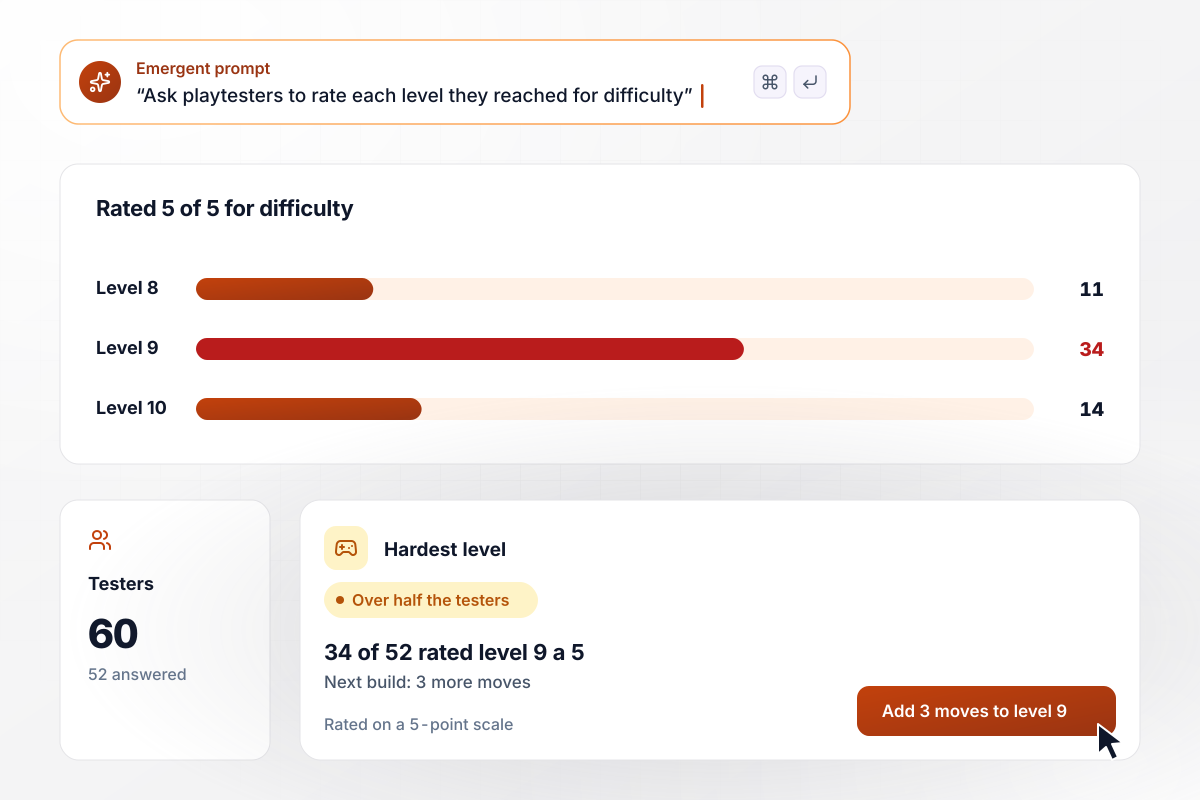
Level 9 gets 3 more moves after 34 testers call it too hard
Quillbright Games sends a playtest survey to the 60 testers of Reefshine, its tile-matching puzzle game. Each tester rates every level they reached on a 5-point difficulty scale. Of the 52 who answer, 34 rate level 9 a 5. The designer adds 3 moves to level 9 before the next build goes out.
window.awbMockup = { playtestFeedback: "Build a playtest survey for my studio's tile-matching puzzle game. After each session, ask every tester to rate each level they reached on a 5-point difficulty scale, and skip levels they never played. Show me, per level, how many testers rated it a 5, and flag any level where more than half did.", gameNightHabits: "Build a member survey for my board game cafe. Ask each member which night of the week they usually come in and which kind of game they reach for first: co-op, party, strategy, or word games. Count the votes for each night and each kind of game, and show me the top night and the top kind.", sessionZero: "Build a session zero survey for my tabletop group of 5 players. Ask each player to rank combat, roleplay, and exploration, and give them a box to list topics to keep out of the game. Save those topics without names, and show me how many players ranked each option first.", surveySaysParty: "Build a survey says game for my company holiday party. Send 8 open questions to all staff a week before. Count matching answers, give me a review screen to merge near matches like charger and phone charger, and put the top 5 answers to each question on a game board I can show on the big screen." };
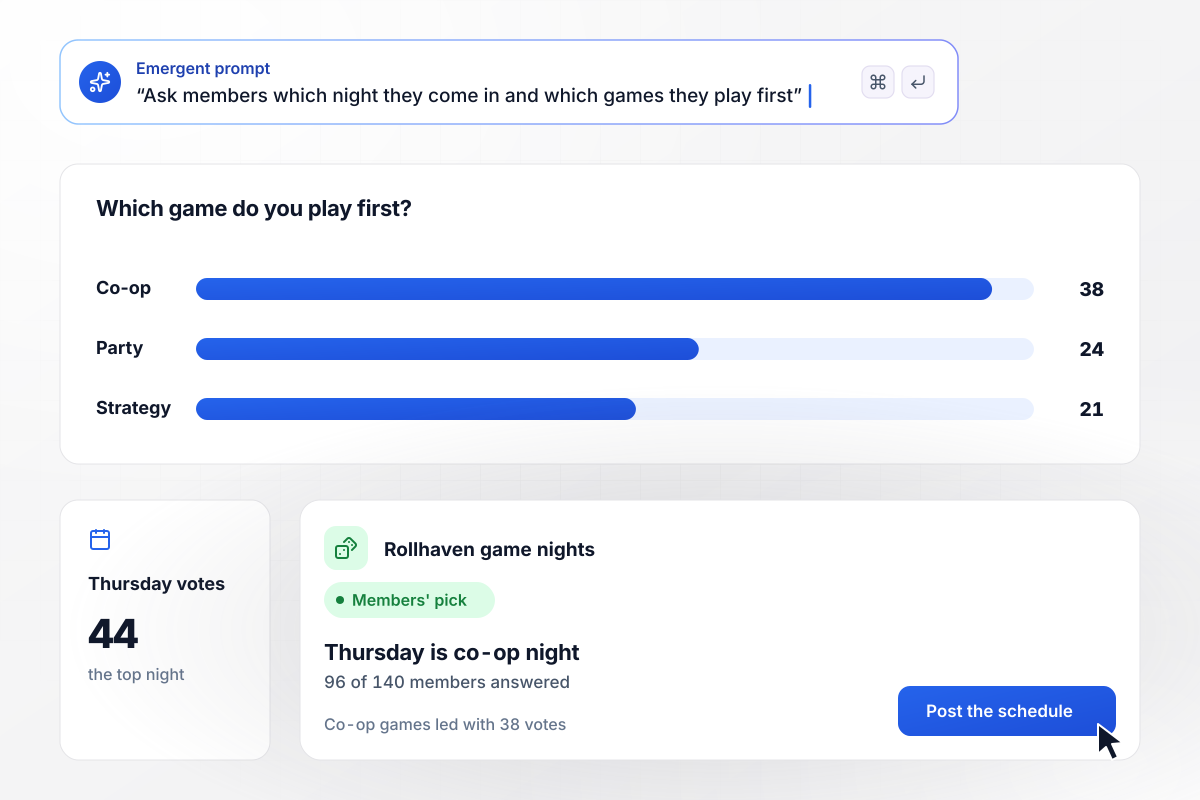
The cafe gives its Thursdays to co-op games
Rollhaven Board Game Cafe has a free night each week and no plan for it. Its survey asks which night each member comes in and which kind of game they reach for first. It goes to 140 members, and 96 answer. Of those, 44 pick Thursday, and co-op games lead with 38 votes. Thursday becomes co-op night.
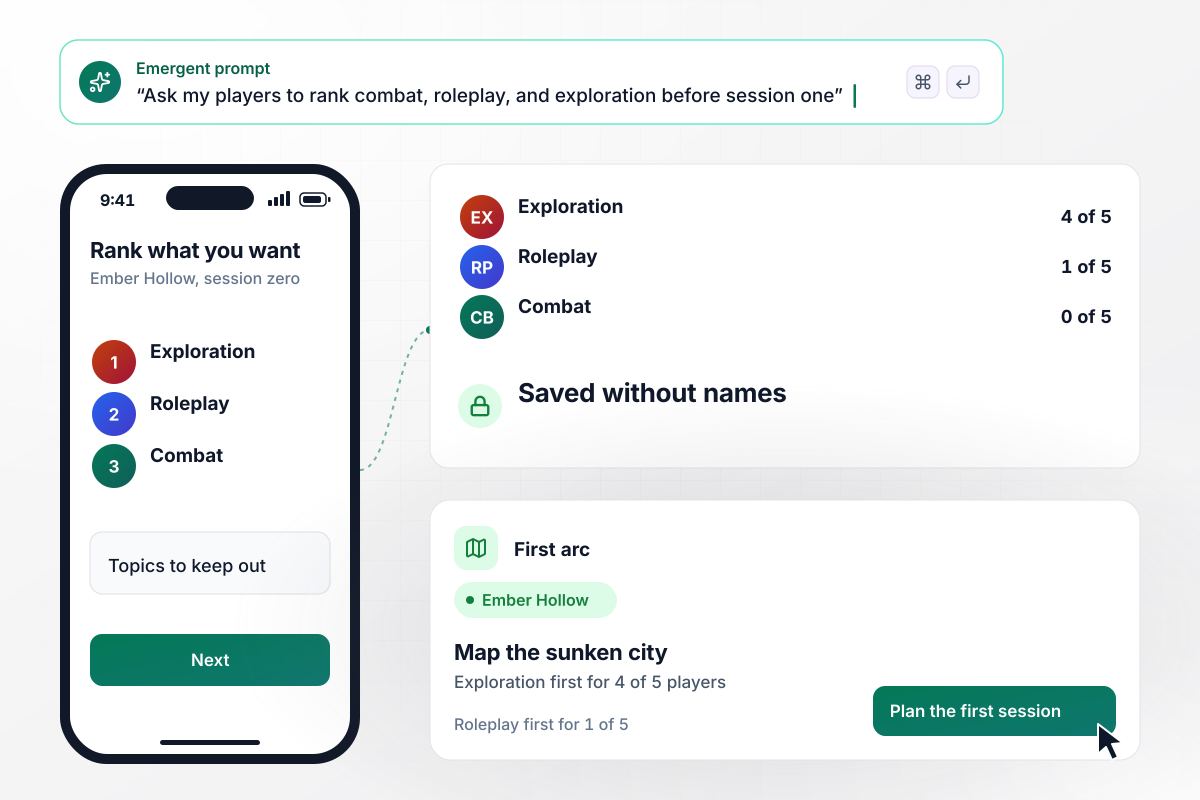
Exploration ranked first before the campaign starts
Five players sit down for the first Ember Hollow session on Friday. The game master's session zero survey has each player rank combat, roleplay, and exploration, then list topics to keep out of the game, saved without names. Exploration comes first for 4 of 5 players, so the first arc is mapping a sunken city.
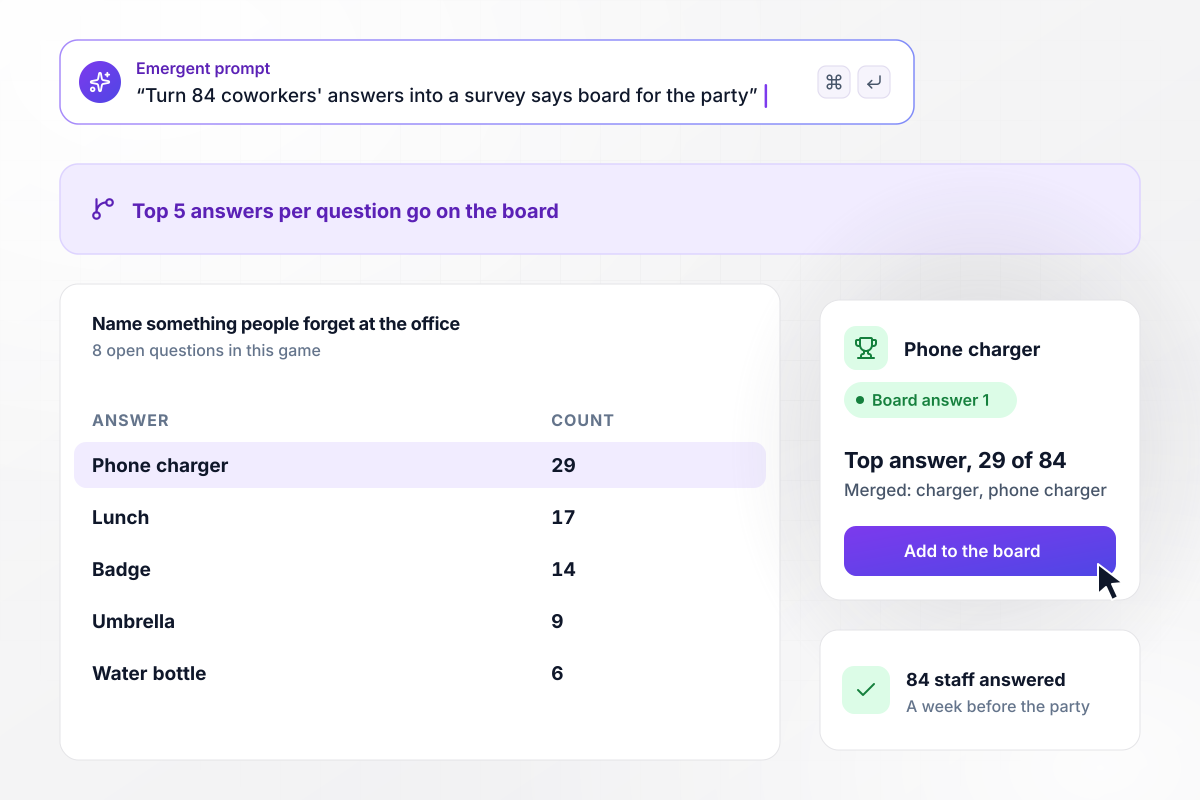
A party game board written by 84 coworkers
A week before the Wexmoor Supply holiday party, 84 staff answer 8 open questions, such as something people forget at the office. The host merges near matches like charger and phone charger. The top 5 answers to each question go on the game board, and phone charger leads with 29 of 84.






How to Write Game Survey Questions
Seven steps to write game survey questions that players finish and that end in a clear decision about the game.
Name the call the answers will make before you write a single question, such as which level to rebalance or which night to book. Put that decision in your prompt, and Emergent drafts questions that feed it.
Send the survey within an hour of the session ending, and ask about that session rather than the whole game. Ask where each player got stuck tonight, while the level and the moment are still fresh in mind.
Use the same 5-point scale for every difficulty or fun rating, and say which end is hardest. A level rated 4 then means the same thing on build 14 and build 15, and levels compare side by side.
Pew Research Center notes that even small wording differences can substantially affect the answers people provide. Ask how hard level 9 was, not whether it was too hard, which tells the player the answer you expect.
Pew Research Center also notes that the order in which questions are asked can influence how people respond. Ask for the ratings first, then end on one open question about what the player would change.
Send the survey to 3 players before the full group, and watch for any question that two of them read differently or skip. Reword it with a follow-up prompt, then send the survey to everyone else.
Tell players what their answers changed, like the extra moves on a level or the new night on the schedule. Post it where they will see it before the next survey goes out, in the same channel the link came through.
Why Build Your Game Survey With Emergent?
Playtest ratings and game-night votes land in one database you own. Change any question with a prompt between sessions.

|
SurveyMonkey | Microsoft Forms | SurveyHero | |
|---|---|---|---|---|
| What you get | Survey, logic, and response database, as code you own | Survey builder with templates, including employee engagement | Surveys, quizzes, and polls with response summaries | Survey builder with templates, including employee satisfaction |
| Pricing model | Credits, no response caps or per-response fees | Per-user team plans with a seat minimum, billed annually | Free with a Microsoft account; included in Microsoft work and school subscriptions | Free plan, then per-account plans with unlimited responses |
| Where responses live | A database table you own, plus any integration | SurveyMonkey account | Microsoft Forms, with export to Excel | SurveyHero account, EU data centers |
| Code ownership | Full code export to GitHub on paid plans | None | None | None |


Pick the Pricing Plan That Works for You
Choose the plan that fits your building ambitions. From weekend projects to enterprise applications, we've got you covered.




Find the right survey, quiz, or poll
for your team
Frequently Asked Questions
Your Questions, Answered
Don't change this element unless you know what you are doing
More things you can build
with Emergent

on Emergent today


