

Build a Royalty Agreement Form That Does the Math on Every Deal
Build a royalty agreement form that works out what each deal owes and saves every agreement to a database you own.
Build a royalty agreement form for my small press that records each author's advance, royalty rate, and list price for every title.
Trusted by Builders Worldwide
Active Builders Worldwide
Apps Successfully Created
Countries Globally Reached



The Terms a Royalty Deal Turns On
A royalty agreement form records what is licensed and on what terms. Six parts keep the numbers straight.
The rate and its base, asked apart
The form asks for the royalty rate and what it is a share of: list price, net sales, or a fixed amount per unit. A rate means little until the form knows what it multiplies.
Splits that have to add up
List each co-writer or co-author with a share. The form will not submit until the shares add up to the whole work, and only then does it ask each person to sign on their phone.
Advances with an earn-out point
Enter the advance beside the royalty per unit. The app divides one by the other and shows how many copies or units must sell before royalties cover the advance and payments start.
Quarterly reports filed against the deal
Licensees file sales through a report form linked to their agreement. The app applies the rate and any minimum and shows the amount due for that quarter next to the sales figure.
A reminder when a statement runs late
Set how many days a licensee has after each quarter to report. When the deadline passes with no report, the app emails the licensee and alerts the rights holder in the app.
Agreements in a repository you control
On paid plans, export the full code of the form and its database to your GitHub repository. Host it on your own servers and keep extending it beside your contract files.
Royalty Deals That Get Signed and Paid
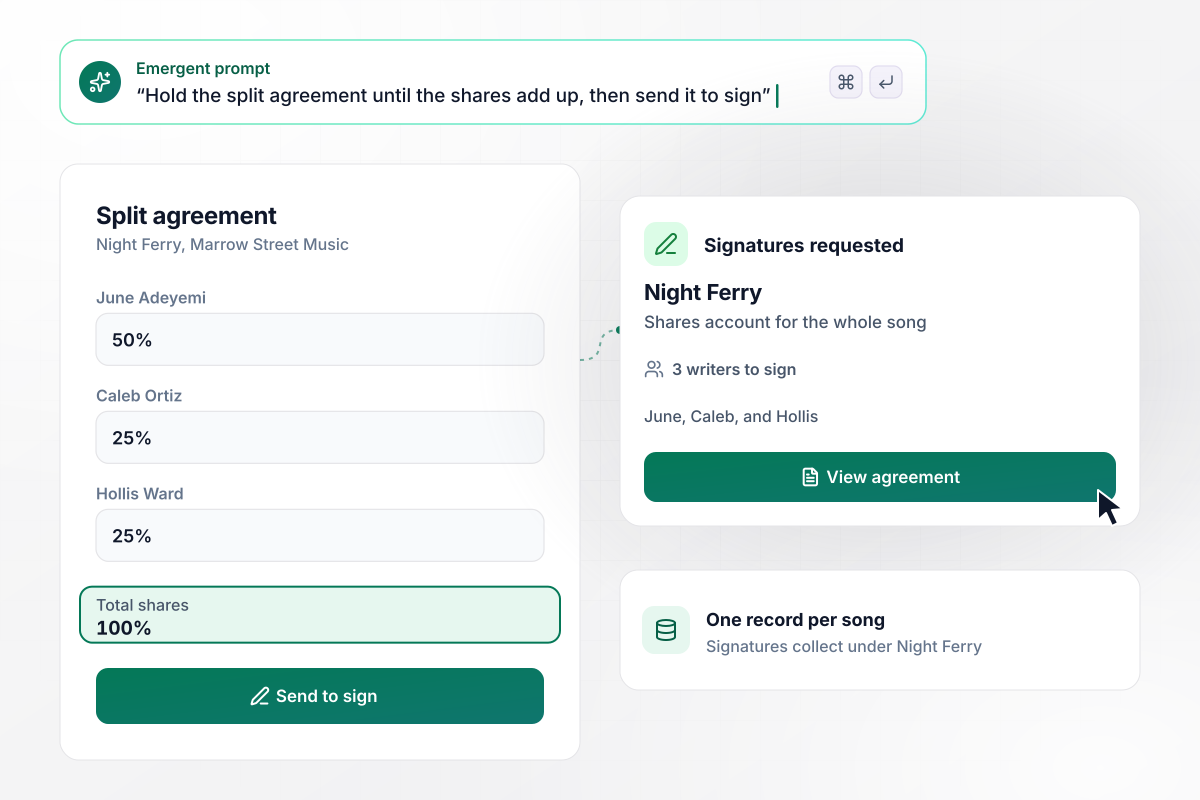
Three writers, one song, shares that add up
Night Ferry has three writers at Marrow Street Music. June Adeyemi takes half, and Caleb Ortiz and Hollis Ward take a quarter each. The form holds the agreement until the shares account for the whole song, then sends it to all three writers to sign. Their signatures sit on one record under the song title.
window.awbMockup = { musicSplits: "I run a small music publisher. Build a split agreement form for each song where I list every co-writer and their share, like 50% to June and 25% each to Caleb and Hollis on Night Ferry. Block the form from submitting until the shares total 100%, then send the agreement to every writer to sign, and keep all signatures on one record per song.", bookPublishing: "My small press pays authors a royalty on list price. Build an author agreement form that records the title, the list price, the royalty rate, and the advance, like 8% on a $16 paperback with a $2,560 advance. Show the royalty per copy and the number of copies it takes to earn out the advance, and keep each agreement in a table by title.", productLicensing: "I license my character designs to toy companies. Build a quarterly report form my licensees fill in with net sales for each product, tied to their license. Apply the royalty rate, like 6% of net sales, and a $1,500 quarterly minimum. Show the amount due for the quarter next to the sales figure, and keep every report in one table.", artLicensing: "I license my photographs to calendar printers. Build a license form that records which photographs each printer uses and when quarterly sales statements are due, 30 days after each quarter ends. If a statement has not arrived by the due date, email the printer a reminder the next day and send me a card that it is late." };
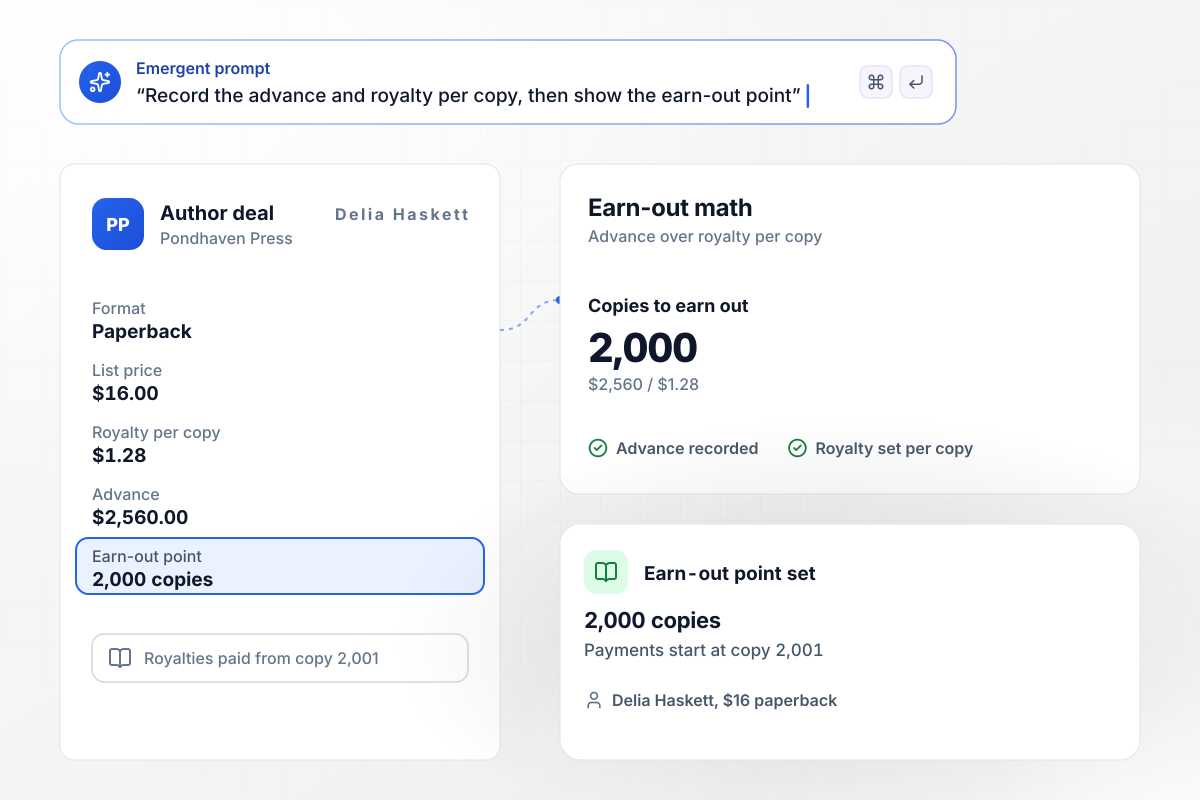
Each paperback pays $1.28 toward a $2,560 advance
Pondhaven Press pays Delia Haskett $1.28 on each copy of her $16 paperback. Her agreement records a $2,560 advance, and the form divides it by the royalty per copy to set the earn-out point at 2,000 copies. Royalty payments to Delia start with copy 2,001.
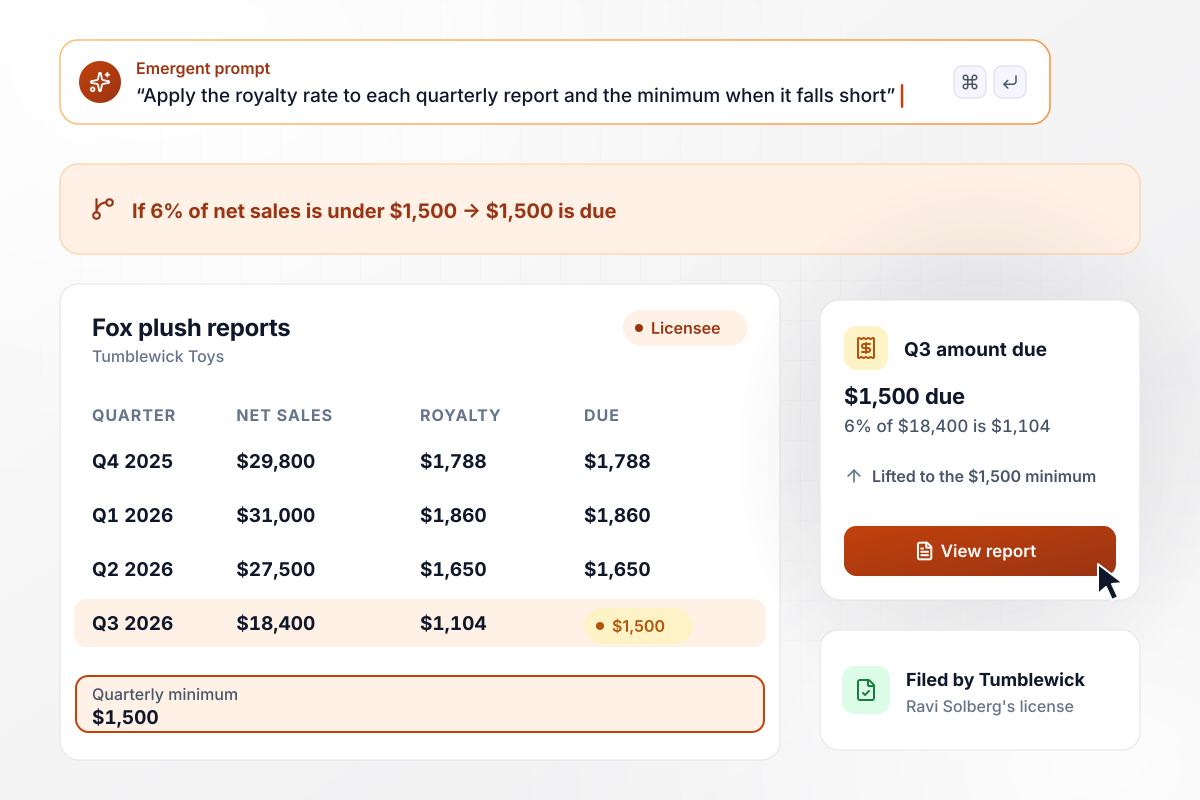
Ravi earns $1,104, which the minimum lifts to $1,500
Every quarter, Tumblewick Toys reports net sales of Ravi Solberg's fox plush through a form tied to his license. Ravi earns 6 cents on every dollar, and Q3 sales of $18,400 come to $1,104. His license sets a $1,500 quarterly minimum, and that is the amount the report shows as due.
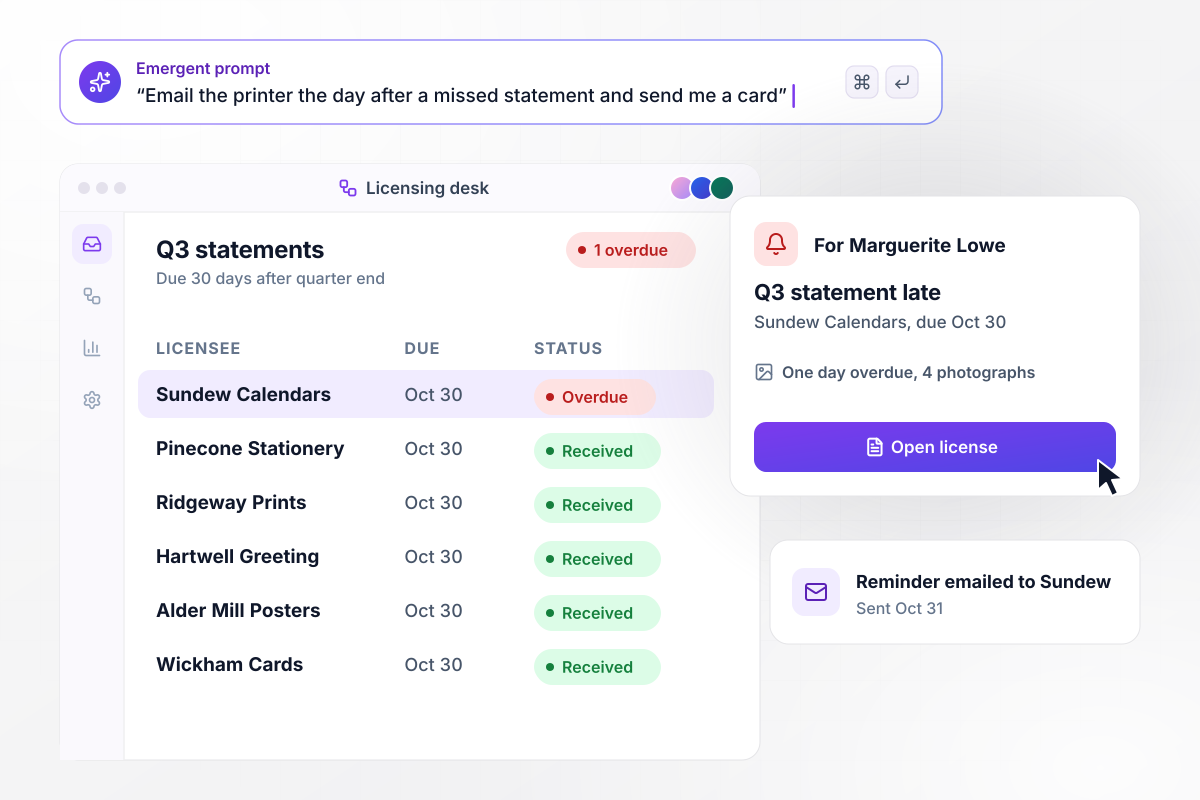
Sundew's statement, overdue by one day
Sundew Calendars prints four of Marguerite Lowe's photographs under license and owes a sales statement 30 days after each quarter ends. The Q3 statement was due Oct 30 and never came. On Oct 31 the app emails Sundew a reminder and sends Marguerite a card saying the statement is late.






How to Create a Royalty Agreement Form
Seven steps that turn your deal terms into a royalty agreement form that collects signatures and chases late reports.
Write down what is licensed, to whom, and for how long. A song split and a character license need different fields. List the kinds of deals you sign before you write a word of the prompt, and note who signs each one.
Pick the base before the rate. A book deal can pay on list price while a toy license pays on net sales. If the base is net sales, define which returns and discounts come off, and both sides will work from the same number.
Record any advance paid up front and any minimum the licensee owes each period. The form keeps both beside the rate, and every report it takes later works out the amount due with them already applied.
Choose how often licensees report sales, such as every quarter, and how many days they get after each period closes. Those two numbers decide when each statement is due and when the app sends its first reminder.
Put the parties and the royalty terms into one prompt, along with the reporting schedule. Emergent builds the agreement form and the report form, with the database behind both. Change a field later by asking for it in plain English.
Name each party who signs, including every co-writer on a split. The app sends the agreement to each of them and keeps the signatures together on one record. Have a lawyer read the agreement wording before the first real deal goes out.
Sign a test agreement between two of your own email addresses, then file a quarterly report that falls under the minimum. Check that the amount due shows the minimum and that the late-statement email arrives the day after the deadline.
Why Build Royalty Agreements With Emergent?
A typed template holds the terms. This form also works out what each quarter owes and flags the statement that never arrived.

|
Jotform | Google Forms | Typeform | |
|---|---|---|---|---|
| How you build | Describe it in plain English | Templates, editor, AI generator | Editor, with Gemini drafting on some Workspace plans | Templates, editor, AI assist |
| Where responses live | A database table you own, plus any integration | Jotform account | Google Sheets | Typeform account |
| Response limits | No response caps | Monthly submission caps by plan; the form stops at the cap | No limit | Monthly response caps by plan; the form closes at the cap |
| Code ownership | Full code export to GitHub on paid plans | None | None | None |

Pick the Pricing Plan That Works for You
Choose the plan that fits your building ambitions. From weekend projects to enterprise applications, we've got you covered.




Find the right form
for whatever you're collecting
Frequently Asked Questions
Your Questions, Answered
Don't change this element unless you know what you are doing
More things you can build
with Emergent









on Emergent today


