

Build a Product Landing Page That Takes Shoppers to Checkout
Create a product landing page from one prompt, with a cart-ready Buy button and a record of the ad behind every click.
Build a product landing page that sells one product and sends buyers to checkout.
Trusted by Builders Worldwide
Active Builders Worldwide
Apps Successfully Created
Countries Globally Reached



What Good Product Landing Pages Do
The parts a shopper sees, and the cart links and records working behind them.
A Buy button that fills the cart
Emergent links the Buy button to a Shopify cart permalink with the variant and quantity already set. A shopper who picks the 12-inch size opens a cart holding the 12-inch size.
One page for each ad set
Ask for a version of the page per ad. The one behind the price ad leads with the price, and the one behind the durability ad leads with the warranty. Both report to one table.
Photos and specs in the order buyers ask
Upload product photos and a spec sheet, and Emergent sets the photo first, then sizes and materials, then shipping, and returns. Captions under each photo stay in your words.
Every click stored with its source
Each Buy click and form entry is saved as a row in a database you own, with the variant and the utm_campaign value beside it. New rows can go on to HubSpot or any tool with an API.
Price changes by message
Send Emergent a message to drop the price to $59 or add a weekend sale banner. The page updates at the same address, and earlier click rows keep the price they were made at.
Code that leaves with you
Export the full code, database included, to your GitHub on paid plans. Publish under a custom domain, included and paid for in credits, or host the files next to your current store.
Product Landing Pages by Selling Job
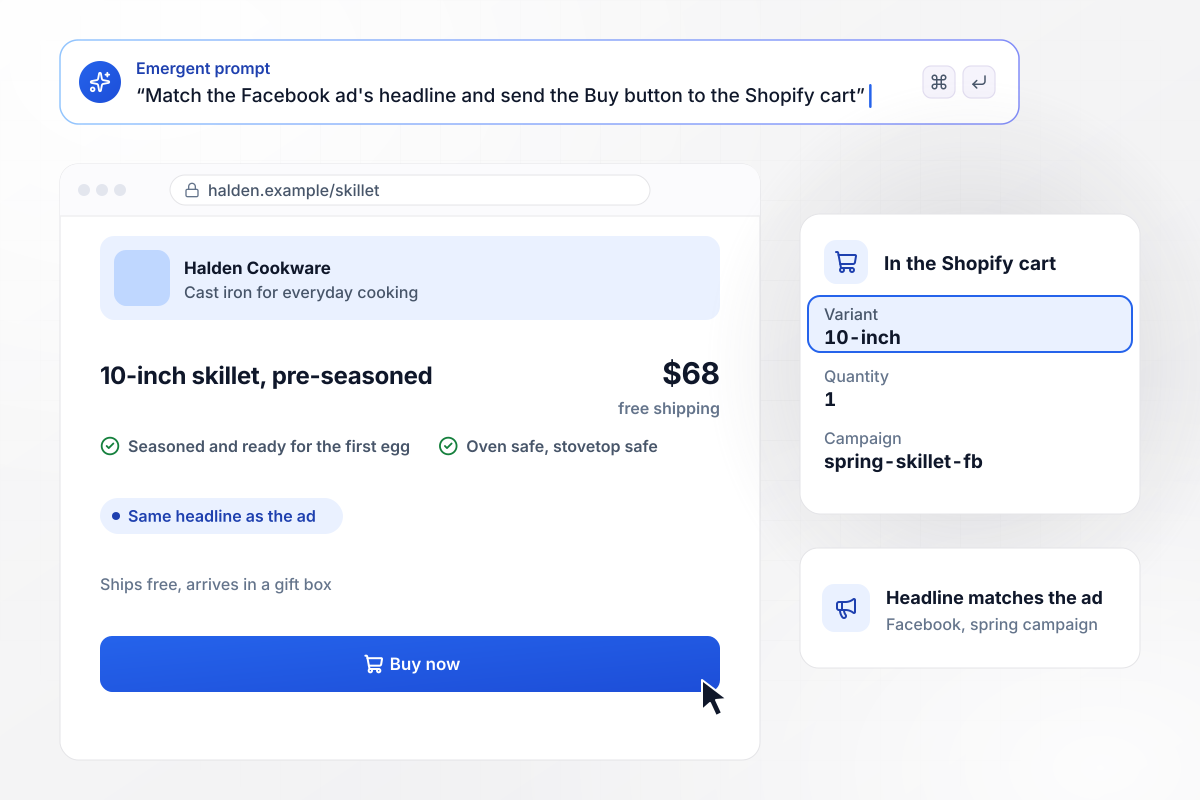
The skillet from the ad, already in the cart
Halden Cookware's Facebook ad offers a 10-inch cast iron skillet, pre-seasoned, for $68. The page behind it opens on the same headline, word for word. Its Buy button is a Shopify cart link carrying the 10-inch variant, and every click is logged with the campaign name, spring-skillet-fb.
window.awbMockup = { adToCart: "My cookware brand, Halden Cookware, is running a Facebook ad for our pre-seasoned 10-inch skillet at $68. Build a landing page whose headline matches the ad. Point the Buy button at our Shopify cart with the 10-inch variant and a quantity of one, and record each click along with the utm_campaign value from the ad link.", modelPicker: "We sell air purifiers in sizes S, M and L, each rated for a maximum room size. Build a product page for Stillwater Air that asks for the room's square footage and recommends the smallest model that covers it, showing its price and a Buy button. Save each answer with the model we recommended.", bundleBuilder: "Fernhill Coffee sells six roasts at $16 a bag. Build a page where a visitor chooses any three and pays $42 for the set, with the $48 single-bag total shown next to it. The checkout link should hold all three chosen roasts. Record bundle orders separately from the rest.", buyerReviews: "Marlow Boot Co. wants reviews from real buyers on our boot page. Two weeks after Shopify marks an order delivered, email the buyer a review form with a star rating and a comment box. Publish every review, low ratings too, and update the average rating shown next to the product name." };
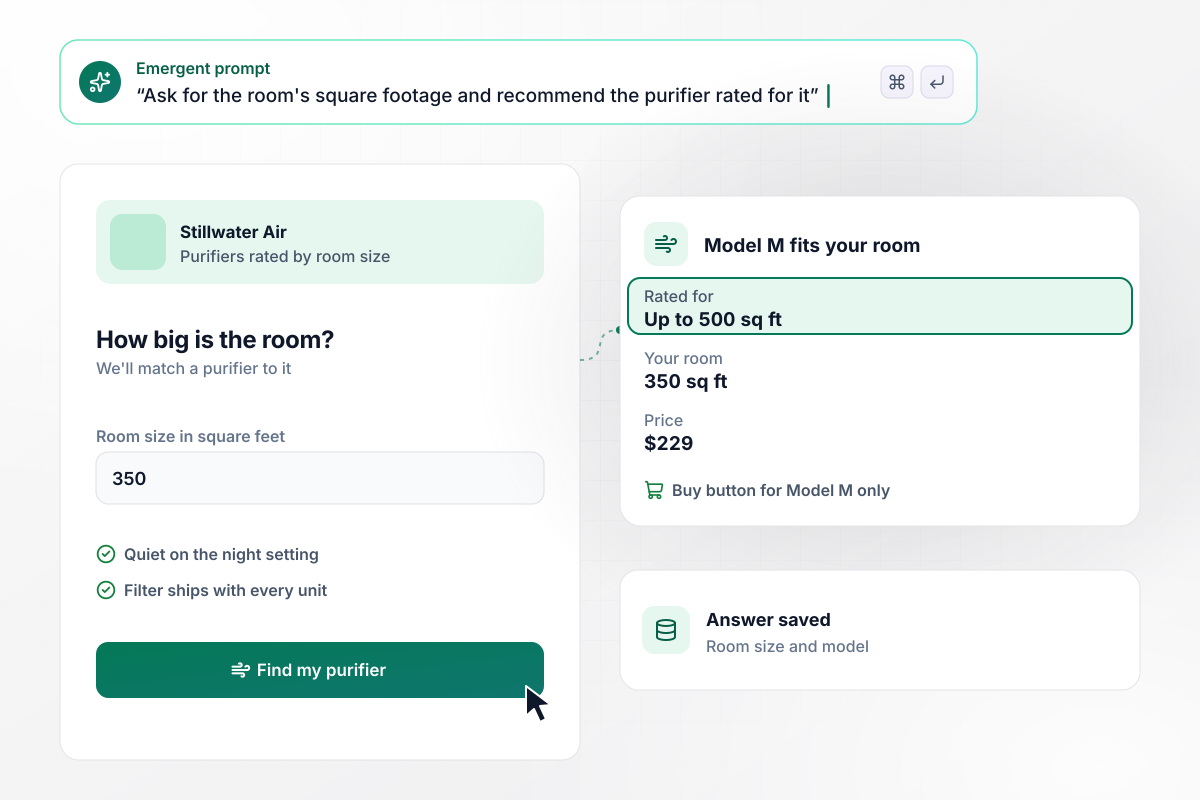
Room size in, the right purifier out
Stillwater Air rates each purifier for a room size, and few shoppers can match a spec grid to their own living room. Its page asks one question instead: how many square feet is the room? A visitor who types 350 sees the Model M, rated for rooms up to 500 square feet, at $229, with a Buy button for that model.
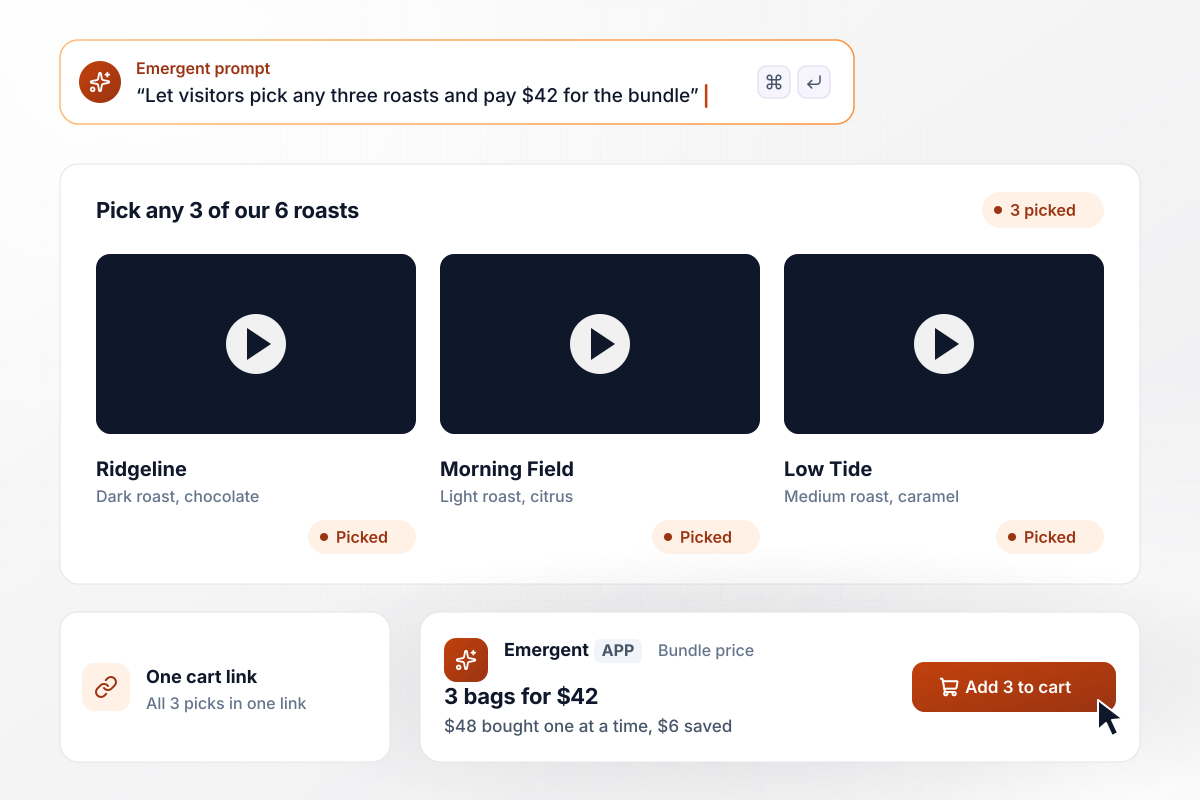
Three bags for $42 instead of $48
On Fernhill Coffee's page, a visitor picks any three of its six roasts, and the price beside the button reads $42, against $48 for the same bags bought one at a time. One cart link carries all three picks. Bundle orders are stored apart from single-bag orders, and that split tells Fernhill whether the $6 discount pays for itself.
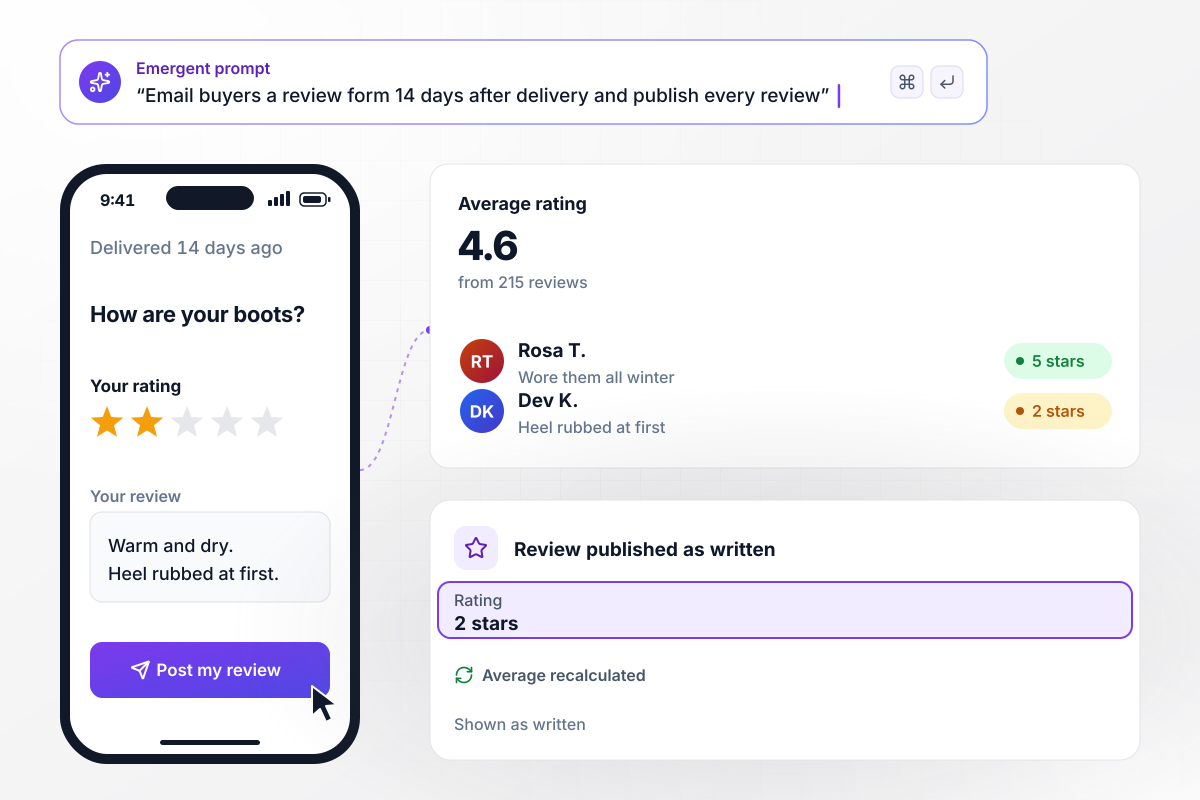
Two-star reviews stay up beside the five-star ones
A buyer of Marlow boots gets an email with a short review form 14 days after the pair is delivered. Every review appears on the product page as written, two-star ones included. The average beside the product name is recalculated with each new review, and this week it reads 4.6 from 215 reviews.





How to Build a Product Landing Page
Seven steps to plan a product landing page around the ad that sends traffic and the cart link behind its button, then build it in Emergent.
Take the headline of the ad or email that will send visitors and make it the page's first line. Google Ads rates landing page experience partly on whether the page gives people what the ad led them to expect, and shoppers judge it the same way.
The product photo and its price belong in the first screen a phone shows, with the Buy button beside them. Further photos go below, with the product in use and next to something familiar for scale. State the price as the shopper will pay it, shipping included.
Before they commit, buyers look for dimensions and materials, then delivery time and the return window. A spec table answers those faster than paragraphs do. Any question your support inbox hears twice a week deserves a line on the page.
On Shopify, a cart permalink adds a set variant and quantity from one URL, in the form /cart/variant_id:1. Give each variant its own link. Pointing the button at the store's homepage makes the shopper search for the product a second time.
Add utm_source and utm_campaign values to each ad and email link before it goes live. Saving them with each Buy click shows which campaigns send buyers and which send browsers who close the tab without opening the cart.
Add Product structured data to the page, with fields for price, availability, and review rating among them. Google Search can show those details as a product snippet under your result. Keep the price in the markup identical to the price on screen, and change both together.
Ask buyers for a review after delivery, once they have used the product, and publish what comes back. The FTC's rule on consumer reviews bars presenting reviews as all or most of them when low ratings were held back for their rating.
Why Build Product Landing Pages With Emergent?
Galleries and templates give you a layout. Emergent builds the page from a prompt, with working cart links and a click record behind it.

|
Unbounce | Landingi | Wix | |
|---|---|---|---|---|
| How you build | Prompt for a campaign page | Templates and drag-and-drop, AI copy assist | Templates and drag-and-drop, AI assist | Prompt for a full site |
| Where submissions go | A database table you own, plus integrations | Unbounce lead storage and integrations | Vendor lead storage and integrations | Wix dashboard submissions and Contacts |
| A/B testing | Generate variants by prompt | A/B testing on higher-tier plans only | Higher plans | Limited or add-on |
| Code ownership | Full code export to GitHub on paid plans | Hosted only | Hosted only | Hosted only |
| Visitor limits | No per-visitor pricing | Monthly visitor caps by plan | Tiered by traffic on most plans | Site plan bandwidth |

Pick the Pricing Plan That Works for You
Choose the plan that fits your building ambitions. From weekend projects to enterprise applications, we've got you covered.




Find the right landing page for you
Frequently Asked Questions
Your Questions, Answered
Don't change this element unless you know what you are doing
More things you can build
with Emergent
on Emergent today




